Carousel with slides shown at a time. Use the Previous and Next buttons to navigate.
Our journey to net-zero¹
Climate change is among the most urgent global challenges, threatening both our environment and our communities. The GLS Group recognizes its responsibility regarding its environmental impact.
The GLS Group is committed to achieving net zero emissions¹ across its operations by 2045, in line with the Science Based Targets initiative (SBTi). This commitment applies to all GLS B.V. affiliated companies operating under the GLS brand, including GLS France. Science-Based Targets (SBTs) guide its efforts to progressively reduce emissions and contribute to global climate goals.
Science-Based Targets of the GLS Group
The Science-Based Targets of the GLS Group are published on the SBTi Target Dashboard under the name “General Logistics Systems B.V.”
How are emissions calculated by the GLS Group and GLS France?
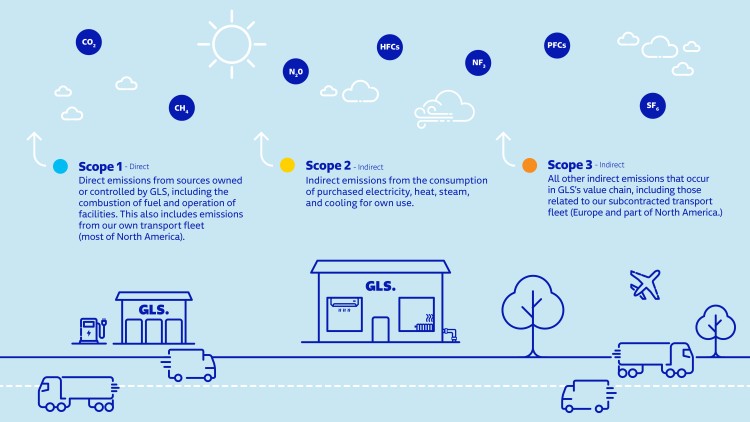
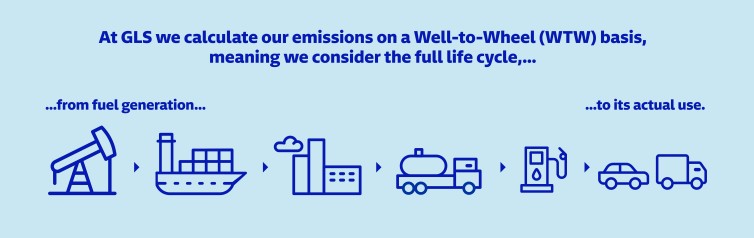
At GLS France and within the GLS Group, we report our carbon emissions Group-wide in accordance with the Greenhouse Gas Protocol.
We include Scope 1, 2, and 3 emissions 6 in our calculation and disclose our emissions in carbon equivalents (CO2e), which means that other greenhouse gases (e.g. methane) are also considered.
Supporting documents
How will GLS France achieve the net zero emissions¹ target by 2045?
Since road transport is at the core of GLS Group’s activities and accounted for approximately 90% of the company’s carbon emissions in 2024, reducing these emissions is at the heart of our transformation efforts.
At GLS France, our emission reduction actions focus on three main areas:
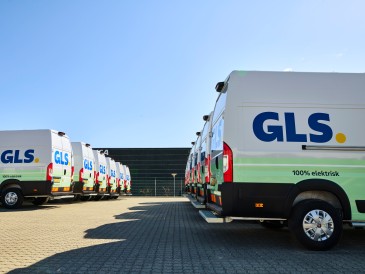
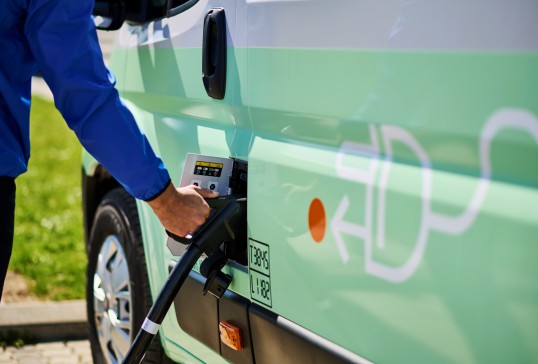
- Transformation of our last-mile fleet: deployment of electric vehicles, bicycle deliveries in city centres, installation of EV charging stations, etc.
- Reduction of emissions from long-distance transport: expanding electric transport routes, using fuel derived from renewable plant-based resources, optimising the transport network, etc.
- Reduction of our carbon footprint beyond direct transport operations: electric company vehicles, electricity from renewable sources, etc.
Discover all our concrete actions to reduce emissions:


1. GLS B.V. is committed to reduce its absolute Scope 1, 2 and 3 greenhouse gas emissions by 90% by 2045, using 2021 as the base year. The residual emissions will be neutralized. This means the business counterbalances up to 10% of its CO2e emissions with investments in carbon removal projects outside its value chain, in line with the SBTi Net-Zero Standard . The Science Based Targets initiative commitment of GLS B.V. encompasses all affiliated companies of GLS B.V. operating under the GLS trademark.
2. GLS France is a subsidiary of GLS B.V. and is included in GLS B.V.'s SBTi commitment. Group SBTs are monitored at the consolidated Group level and do not represent individual targets for subsidiaries, such as GLS France. These companies may perform above or below the Group targets, while the Group as a whole remains compliant with the overall consolidated Group SBTs.
3. The Science Based Targets initiative defines Scope 1 emissions as “direct GHG emissions from activities owned or controlled by the reporting company”.
4. The Science Based Targets initiative defines Scope 2 emissions as “indirect GHG emissions associated with the production of purchased or acquired electricity, steam, heating or cooling consumed by the reporting company”.
5. The Science Based Targets initiative defines Scope 3 emissions as “indirect GHG emissions (other than Scope 2) generated in the reporting company's value chain, including both upstream and downstream emissions”.
6. GLS accounts for emissions from its subcontracted transport fleet (in Europe and parts of North America) under Scope 3, and those from its own fleet (primarily in North America) under Scope 1. Scope 3 covers all indirect emissions (other than Scope 2) generated in GLS's value chain, including upstream and downstream activities. For more details, see GLS reporting criteria .