Carousel with slides shown at a time. Use the Previous and Next buttons to navigate.
Our journey to net-zero¹
Climate change is one of the most pressing global challenges, posing significant risks to our environment and communities. At GLS , we acknowledge our responsibility to address our environmental impact.
We are committed to achieving
net-zero across our operations by 2045, in line with the Science Based Targets initiative (SBTi). Our science-based targets (SBTs) guide us in our efforts to gradually cut emissions and ensure that our reduction path aligns with global climate objectives.
Our environmental roadmap
Our environmental roadmap outlines the key milestones on our journey to net-zero by 2045. It combines our science-based targets with operational ambitions that support the gradual reduction of greenhouse gas emissions across the GLS Group. The roadmap focuses on the areas with the greatest potential to reduce emissions, including transport operations, electricity consumption at our sites and business travel.
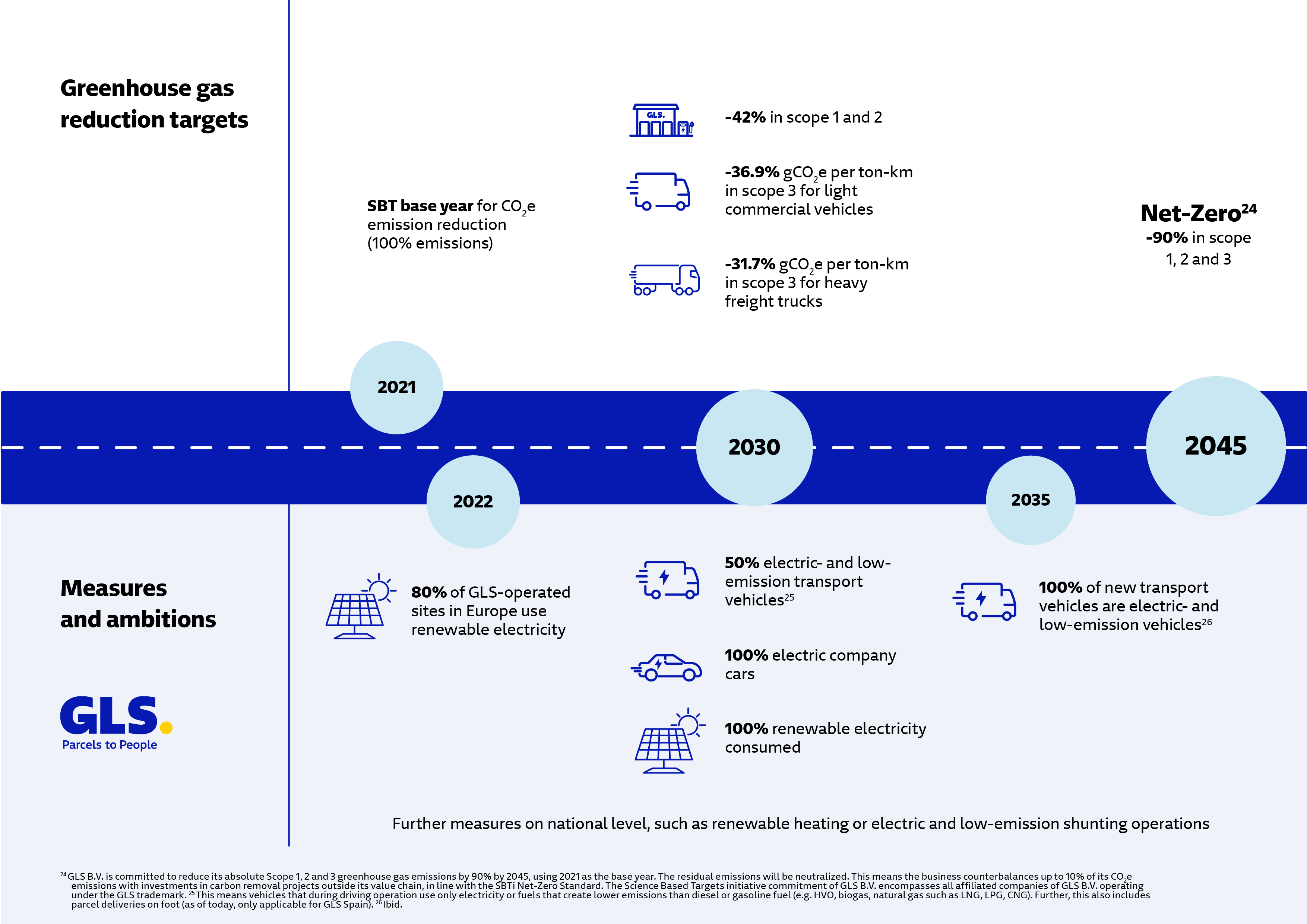
Our roadmap is underpinned by internal decarbonisation plans for our transport fleet and our buildings, which translate these ambitions into concrete measures at country level. While implementation measures vary across GLS countries due to differences in infrastructure, technology availability and local market conditions, all countries contribute to our Group-wide environmental strategy.
The targets and ambitions were approved by the Management Board. Progress towards these milestones is tracked as described in “ Our Governance and Monitoring ”.
How we will achieve net-zero¹ by 2045
Since road transportation services are GLS' core business and accounted for approximately 88% of the company's carbon emissions in 2025, reducing emissions in this area is a central lever of our environmental strategy.
As part of our group-wide environmental strategy, we are focused on converting the predominantly subcontracted transport fleet to
electric and low-emission modes , such as electric vans, cargo bikes, and the usage of biofuel and biogas. Measures for introducing these vehicles vary by country, tailored to local market conditions to maximise individual impact. To support this fleet transformation, we are investing in infrastructure upgrades at our depots, including the installation of charging infrastructure, enhancements to the power supply, and the implementation of load balancing systems and electricity meters.
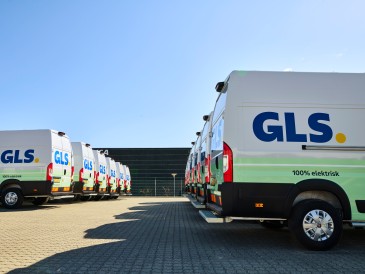
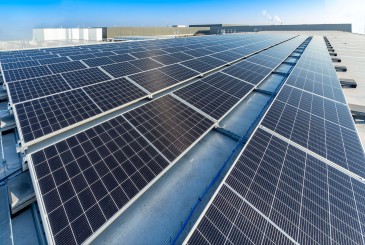
Furthermore, we are upgrading our existing depots and hubs to reduce our CO2e emissions by increasingly using renewable electricity and installing photovoltaic systems. We are also replacing fossil heating systems with renewable options, such as electric heat pumps. In addition, we are gradually increasing the share of electric company cars across the GLS network and expanding supporting charging infrastructure.
As infrastructure availability, technology maturity and regulatory frameworks differ across markets, implementation measures may vary by country. The pace of decarbonisation also depends on factors such as vehicle availability, charging infrastructure, grid capacity and technological development. We take a holistic approach to these challenges, seeking solutions both within our corporate boundaries and in collaboration with our business partners.
For an overview of key KPIs tracking progress on these measures, please see our
Environmental page .
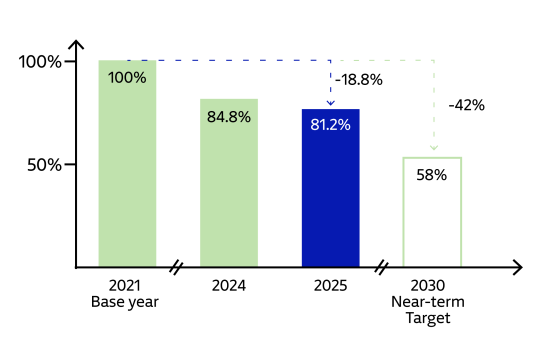
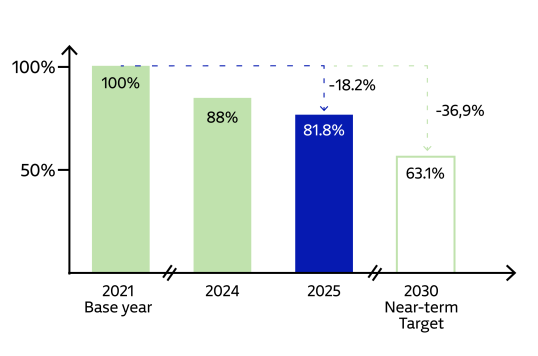
Measurable progress towards our 2030 SBTs
GLS regularly monitors progress towards its science-based targets and reviews performance against the 2021 base year (see “ Our Governance and Monitoring ”).
The charts below show our performance in 2024 and 2025 compered with our 2021 base year and illustrate our progress towards the 2030 near-term targets for
Scope 1 and 2 emissions,
light commercial vehicles (LCVs) and
heavy freight trucks (HFTs). The progress shown below reflects the impact of measures implemented across our transport operations, buildings and company car fleet in support of our transition plan.
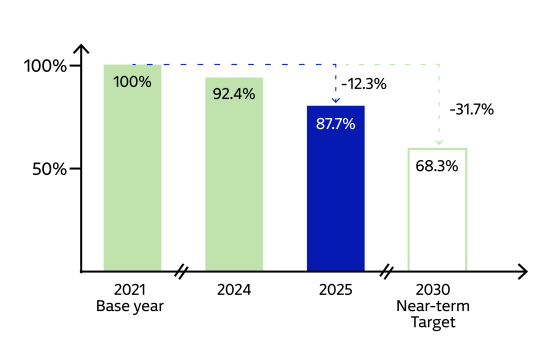
Progress is assessed annually as part of our environmental strategy and
ESG reporting processes. Underlying GHG data and SBT progress indicators are subject to independent limited assurance by a third party. Further information is available in our
Assurance Statement . Learn more about how we calculate and report our greenhouse gas emissions in our
Basis of Reporting .
Further background information
GLS's science-based targets
GLS’ science-based targets are published on the SBTi target dashboard under “General Logistics Systems B.V.”.
Emission calculation methodology
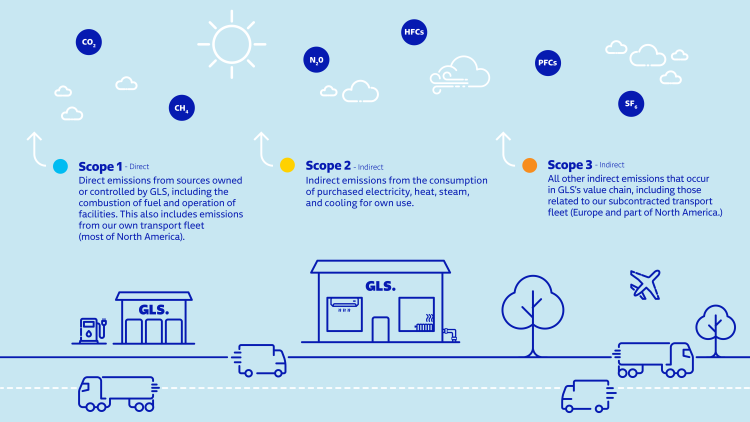
At GLS, we report our carbon emissions Group-wide in accordance with the Greenhouse Gas Protocol .
We include Scope 1, 2 and 3 emissions in our calculation and disclose our emissions in carbon equivalents (CO2e), which means that other greenhouse gases (e.g. methane) are also considered.
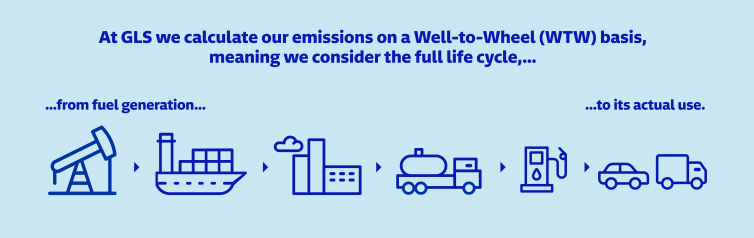
Transport-related greenhouse gas emissions are calculated in accordance with ISO 14083 , an internationally recognised standard for quantifying and reporting emissions from transport operations. Our reporting follows a transparent methodology that is documented in our Basis of Reporting .
Financing the transition
Achieving our science-based targets requires sustained financial commitment. GLS allocates both operating and capital expenditure to decarbonisation measures across the Group, with resources deployed at both group and country level to reflect local market conditions and implementation needs.
Investment needs are identified through our decarbonisation roadmaps and considered as part of regular business and investment planning processes at Group and country level. Where relevant, larger investment proposals are reviewed through established governance and investment decision processes at both local and central level.
We recognise that achieving our net-zero target depends not only on our own investments, but also on the wider transition of the logistics sector, including the availability of suitable electric and low-emission vehicles, charging and energy infrastructure, grid capacity, technology maturity, energy market developments and the investment readiness of transport partners. We therefore work closely with transport partners, vehicle manufacturers, energy providers and other relevant stakeholders to support this shared transition.
Governance and monitoring
Our environmental strategy supports the delivery of our CORE 2030 strategy and is integrated into the Group’s overall business strategy. It provides the framework for implementing our transition plan across the GLS network. Environmental priorities, targets and measures are coordinated at Group level, while GLS countries are responsible for implementation and adaptation in consideration of local market conditions, regulatory requirements, infrastructure availability and operational requirements. Our transition plan is underpinned by dedicated roadmaps for the transformation of our transport fleet and our buildings, with targets broken down to country level.
Dedicated Environmental Managers in each national GLS organisation support the implementation of measures, monitor performance and facilitate the exchange of environmental best practices across the GLS Group. At Group level, the Corporate Environment & Climate Strategy team coordinates the environmental strategy and tracks progress against our science-based targets and transition plan.
Selected operational indicators are tracked on a quarterly basis, while overall progress against our SBTs is assessed annually and reviewed against our 2021 base year. Progress updates, relevant key performance indicators and climate- and environment-related risks are regularly reported to dedicated governance bodies, including the ESG Committee, the Risk Committee and the Management Board. Updates to the ESG Committee and the Management Board include relevant decarbonisation indicators, such as greenhouse gas emission reductions, progress against science-based targets and the implementation of electric and low-emission vehicles by third-party transport partners. The Risk Committee is informed about climate- and environment-related risks to support transparency and timely mitigation where required.
Progress against our environmental objectives, roadmap and SBTs is disclosed annually through our ESG reporting . Selected environmental key performance indicators are subject to independent limited assurance . Further information on the scope of reporting is available here .
Where applicable, ESG-related objectives may also be considered in management incentives, supporting alignment between strategic priorities and the Group’s environmental agenda.
Supporting documents
1 GLS B.V. is committed to reduce its absolute Scope 1, 2 and 3 greenhouse gas emissions by 90% by 2045, using 2021 as the base year. The residual emissions will be neutralized. This means the business counterbalances up to 10% of its CO2e emissions with investments in carbon removal projects outside its value chain, in line with the SBTi Net-Zero Standard . The Science Based Targets initiative commitment of GLS B.V. encompasses all affiliated companies of GLS B.V. operating under the GLS trademark.